
What is the one question I get asked all the time? “Why do I need to teach that?” Other teachers and homeschoolers often tell me how much they love my units and how thorough they are, but it is often followed up with, “But why would I spend time teaching that to my students?” I get it, I really, truly do. As special education teachers, we are expected to deal with so much and often have so little support. We are dealing with significant behavioral challenges and often time-consuming physical needs that so many of our students deal with. It is hard enough to get through the day just keeping everyone safe, happy, clean, and sane. But, I challenge you to think back…
Why did you become a teacher?
For me, it was the pure love of learning and the desire to share that excitement and discovery with others. Just because I chose to teach special education and taught the most profoundly affected students in our county did not mean my reason for teaching changed. It just got more complicated, a WHOLE LOT more complicated.
So, let me share with you the biggest reason I think it is worth finding a way to teach REAL curriculum in a meaningful, engaging, age-appropriate way that is worthwhile for you and your students.
It is a GREAT way to teach other (incredibly important) skills while getting your students excited about learning and keeping you excited about teaching.
As I gathered my small but boisterous class of 7 students, ages 5 to 12, I faced the challenge of figuring out how to keep this diverse group of kiddos engaged, calm, and learning. It is not easy, and it is (more often than I want to admit) not always that successful. But, I am persistent and optimistic that I will hit on just that right combination to keep all those eyes looking at all those hands in their laps and me.
It is November, and we are learning about life in colonial America. I read the book I have written and illustrated with photos to the group. I have been reading this same book for the past 7 days, so by now, some are excited to chime in. But more importantly…
***They are all sitting (relatively still) and looking at me (or at least in my general direction).***
That is a HUGE skill they have learned. They can sit quietly while the teacher is reading without distracting the other students around them. It has taken a while to get to this place, and every time we start a new topic with a new book, some relearning is required. But it is an awesome sight.
I ask the youngest, non-verbal student what he sees on this page (it is a photo of a wild turkey). He looks down at his communication device, and with some help from my amazing assistant, finds the correct picture and tells me it is a turkey.
***It has taken 3 months, but he is using his communication device to tell me what he has learned!!***
So many of my students have had communication devices. It seemed like every single device was different, and they all required my time and attention (and fresh batteries) to keep them working and relevant to what we were studying. Oh, and my sweet little kiddos (of course) all wanted to play with their neighbor’s device instead of their own. Teaching students how to use their communication devices may seem easy to an outsider. Still, it takes a lot of time and a very conscious effort on the part of the teacher and the assistant to make it part of their regular communication. Having well-planned lessons has helped me do that.
My oldest student has some super challenging behaviors. He is one of those kids who will strike out at you so quickly you don’t even see it coming. But he has to sit near me to keep the other students at a safer distance. He wanted to answer the turkey question, and I can tell he is angry that someone else got to do it this time. I prompt him (by pointing) to his “I need a break” card, and he throws it at me. “Yes, you can take a break,” I say. Off he goes to a quiet corner to regroup.
***He did NOT hit me. He did NOT hit another student. He did NOT get to be in charge of the lesson and answer every question. He DID ask to take a break. He DID (eventually) return to the group.***
Working on behaviors is something we do every minute of every day in special education. I find this can be the most difficult part of my job because these behaviors are often so complex and need carefully constructed plans and strategies to overcome. But I don’t want to work on them in isolation. It just does not seem practical (and not much fun for the student or me). I want to work on them while I teach. This, again, takes a lot of pre-planning and clear communication with all the other adults in the room, but I have found I am happier when I can address those things while doing what I love. And, if I am happier, I am more likely to follow through and be consistent with my plan and strategies.
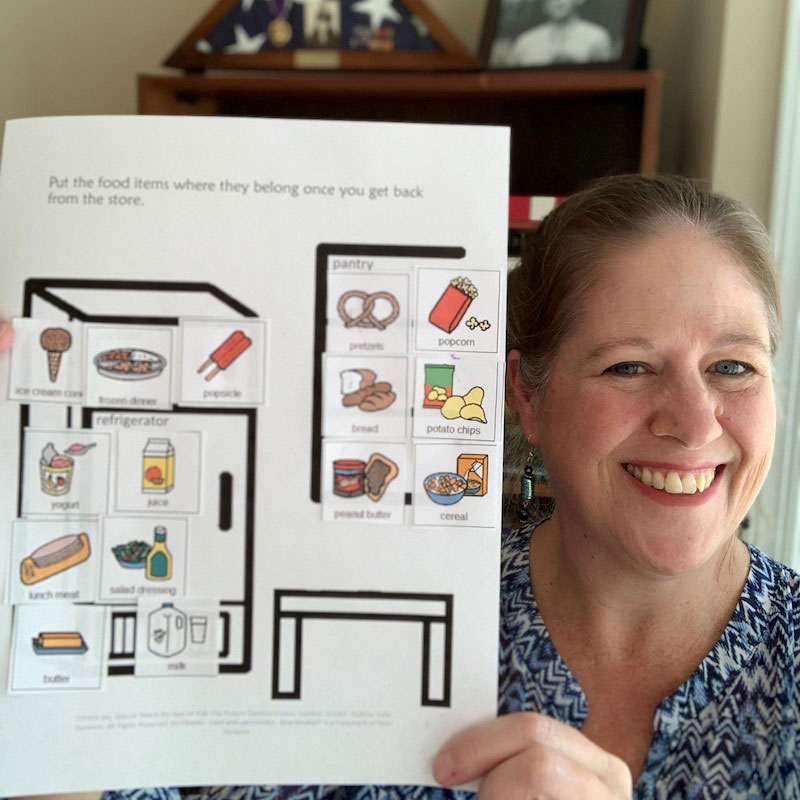
After we read the story, we “talk about it for a bit,” and then I have a planned activity. Today, we are sorting what the pilgrims were likely to see on a typical day versus what they were unlikely to see. I have ONE activity for all 7 kids. And, believe it or not, I can differentiate it so they can all participate with some form of independence. Here are some things I typically do:
- Pre-cut out pictures for students who really struggle with scissor skills
- Gather a few simple objects for a student who is really struggling. I have a piece of corn from the kitchen play center and a jeep from the car bin.
- Use color coding for students who need a little more help. This is a quick and easy technique that you can read more about here:
- Challenge my highest kiddo (who has just returned from the chill-out area). He gets a blank sorting template and a pencil. He can either look at everyone’s pictures for ideas or come up with his own for each column.
***They are all working as independently as they can (with the help of some amazing assistants) on the SAME activity.***
This may sound like a crazy amount of prep-work, but I don’t know how else to do it. I am not a big fan of hand-over-hand assistance. I love using eye gaze with my students who have significant gross motor challenges. I give them two choices to look at, and they choose the one they want by looking at it. Is everyone’s activity correct? Absolutely not. But I guarantee you that parents don’t want perfect work coming home all the time. They want to know their kids are doing things themselves. Do we talk about the wrong answers? Of course. I also encourage parents to talk about their kids’ work.
Really, I could go on and on with the various skills my students learn as we work through these units. But here is the main point:
I think we would all agree that these are super important skills to work on.
So why not work on them within the real curriculum? I know materials are not easy to find. I have spent years making things for myself. But it is so worth it. It won’t be perfect right away. But you can get there. Never underestimate what a kid can do.
2 Comments
Christa Joy, I want to say thank for all the time you put into units! I am currently homeschooling my special needs son due to medical conditions and it has enabled me to continue his education with content that is relevant. My husband is also a special education teacher and we both appreciate the time you have spent putting together units and allowing all to be included! Thank you again!
Oh Kim you are so welcome and bravo to you for taking on the burden of homeschooling. I truly admire you for trying to giver your son what he needs which I know comes at a cost to you and your family. I am so glad this makes it a little easier. Best of luck!!
Comments are closed.