Developing a good lesson plan template for a special education setting is challenging. No one template will fit all needs, but here is one that was effective and efficient for me. You can download the free lesson plan template at the bottom of this post.
But there is one thing I found that, once I added it to my lesson plans, truly changed the game for my students and me.
So what was it?
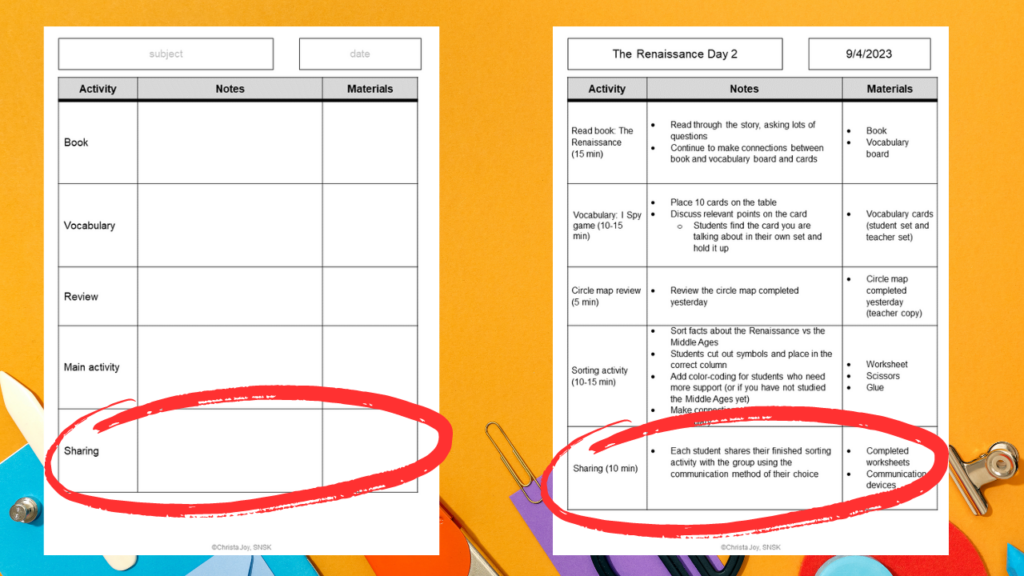
Spending time at the end of every lesson for students to share their finished work with the group.
Sounds simple and seems obvious? Perhaps, but it took me a while to realize its value, and looking back now, I realize it likely made the biggest impact on my students.
You will find this in the last part of the lesson plan template provided below, but first, let me explain how it works and the value it brings to student management and learning.
The process is fairly simple, but there are some key components:
- Allow students to share their work using the communication mode of their choice.
- Allow students to share as much or as little as they feel comfortable.
- Allow students to ask for help from a peer (not an adult)
- Repeat/reflect back to them what you believe they are trying to share.
- Reward, reinforce, and praise all efforts, big and small.
1. Using the communication mode of their choice

This is THE MOST important component of all when allowing students to share their activities.
Many students have communication devices they regularly use. They are encouraged to use those devices as often as possible, across settings, and with many different people. Therefore, you want to give students the freedom to share their finished work using their own communication devices.
This is also a great opportunity to collect IEP data on a regular basis regarding the use of that device.
2. Allowing students to share a lot or a little
It is important to allow students the freedom to share as little or as much as they want about the activity they just completed.
As the teacher, you can certainly chime in with probing questions or share your own observations if a student is only willing to hold up their paper.
The key is respecting their choice of how and what they choose to share. When students feel safe, they are more willing to share and use their communication devices.
3. Asking for help
Some of your students may be even more impacted and unable to participate without some assistance. But they can still participate and share what they have learned.
If you have a student who needs a lot of assistance, try to incorporate their peers rather than an adult to help them. The student can ask a friend to help (like holding up the paper or pointing to things), or you can ask the student if they would like a friend to help.
Asking for help and social interactions are included in many IEPs. This provides an excellent chance for you to collect data on those goals in a natural setting.
4. Repeating what you heard
Showing a student you “hear” them is very powerful. This is especially true of students who rely on communication devices.
Giving positive feedback, even if it is on their color choices, their comprehension of the content, or even simply their scissor skills, can reinforce their use of those devices and show them that they are heard and understood.
Regardless, repeating back what a student shared with the group is another opportunity to reinforce what they had been learning that day.
5. Rewarding any effort

This is the easiest component of all.
As special education teachers, we are trained better than most to watch for when our students are doing the right thing. We are constantly rewarding and praising good behavior, and often ignoring less desirable actions.
So, this is likely a natural extension of what you are already doing in the classroom. But it is still worth mentioning because rewarding a desired behavior will likely increase the likelihood that the behavior will continue.
I hope this inspires you to consider giving students the time and opportunity to share their finished work at the end of the lesson.
It is absolutely the best thing I have ever added to my lesson plan.
And now for that lesson plan template, I promised.
Just click the button below to get immediate access to a PowerPoint template and example you can use.
2 Comments
Comments are closed.