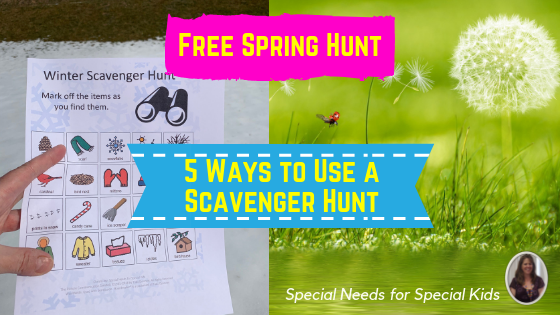
Let’s learn about different ways to go on a spring scavenger hunt!!
I love finding more than one way to use the same activity. It cuts down on the number of activities I need to create and allows students to use the same skills across different settings, with other people, and using various stimuli. Generalization. Yep, it is important and can take some time and strategy to implement. Here are five ways to use a scavenger hunt to build up that generalization of skills and save you some precious time.
Plus, I have a free scavenger hunt you can download for Spring to try it out.
1. Going Outside for Your Scavenger Hunt
This is probably how most of us use scavenger hunts. We give the kids a list of things to find, and off we go. Of course, with some of our kiddos, we need to use pictures rather than words. And for some, we may even need to use real photos. I also like to think about HOW kids will mark their list once they find an item. I try to mix it up and find cool or fun ways to mark their boards. You can try:
- stickers
- post-it notes
- dot markers
- hole punch
You also need to decide if each student will carry their list or if you will take along a class list. Depending on the makeup of my class, I have done it both ways.
2. Watching a Movie for Your Scavenger Hunt

If it is too cold or wet, you can always do a scavenger hunt with a movie. This sometimes increases engagement, as the students are watching for things on their list. On the other hand, you can have students who become so involved with the movie that they forget about the scavenger hunt. I like to use movie-related markers to keep them focused on the list as much as possible. You can try:
- Small candies, like Skittles or gummy bears
- Popcorn
- Movie tickets (you can a roll cheaply at the dollar store)
Special note: If you happen to watch a movie following one of my novel units, you can use the vocabulary board as your scavenger hunt list.
3. Going on a Scavenger Hunt in a Book

Just like watching a movie, you can create a scavenger hunt for a read-aloud you are planning to do. It will not only increase engagement by providing a clear purpose to listening to the story but will also reinforce and generalize vocabulary you may be working on from that book. For markers, I like to use:
- Small novelty erasers
- Post-it notes
- Dot markers
Special note: If you use one of my literacy units, you can actually use the vocabulary board as your scavenger hunt list.
4. A Scavenger Hunt Through the School

A scavenger hunt around the school or even just in the classroom is a great back-to-school activity. You can work on all types of behaviors and expectations in all different areas of the school. Again, because the exploration has a clear purpose, students are more likely to stay engaged and follow the rules.
Special Note: You can check out my blog post on Structured Walks for a structured and pre-planned scavenger hunt. This works well for students who are new to you or at the beginning of school. The post has a free guide and a free walk you can download.
5. Doing a Scavenger Hunt While on a Field Trip

If you are planning a field trip, why not include a scavenger hunt? Again, adding an additional layer of purpose to the trip will increase student engagement. Reviewing the list beforehand will also front-load your students with information to make the trip more meaningful.
Special Note: For even more tips on making the most of your outings, check out my blog post on Having a Successful Field Trip.
There are so many ways to use scavenger hunts in your lesson plans. I know they take some work to put together, but once you have one, you can use it year after year. You can even use the same scavenger hunt multiple times in multiple settings. Finally, consider all the IEP goals you can likely target during this activity. I found them to be one of my favorite things to do with my students.
Here is a scavenger hunt for spring that you can download and try. Click the image to download it now.


3 Comments
Comments are closed.