Most high school teachers cover the California Gold Rush. But if you are in special education, making the California Gold Rush accessible and meaningful to kids can be quite a challenge. Good thing I like a challenge. So, if the Gold Rush is in your curriculum, then read on for some great ideas, including a free panning for gold simulation you can do with your students in the classroom, without the mess
The history of the California Gold Rush
It is VERY unlikely you will find a textbook that covers the California Gold Rush in a way accessible to students with significant learning challenges. But, when it comes to coming up with ideas for the California Gold Rush for kids in our classrooms, there are some great options.
Write your own book
I know this can seem daunting and time-consuming, but writing your own book about a topic can be an extremely valuable addition to your classroom.

I wrote a blog post on how to write your own book that breaks down the exact process for you and highlights all the advantages. But, in a nutshell, this is a fairly easy process. One of my favorite websites to use is Ducksters.com. It has a great summary of many science and social studies topics, and it is often where I start my research.
Go to YouTube
If you just don’t have the time to write a book, another great way to find information on the California Gold Rush for kids is YouTube. There are so many great informational videos there. Videos, especially those with music, are a great way to connect with our students.
I have an entire blog post outlining all the benefits of using music as a teaching strategy. You can download a list of almost 200 videos (with links) that correspond to a particular topic. This is a GREAT list to have on hand for quick reference.
Finding and creating appropriate activities
Now that you have tackled the informational aspect of the California Gold Rush, it is time to determine which activities your students would benefit most from.
Vocabulary
I would definitely consider creating activities around the new vocabulary that your students will be learning about the Gold Rush. I like to try to find 12-16 vocabulary words to target. This is a large enough number to do some engaging activities within a small group without being overwhelming.

There are so many ways you can use these cards. I have a blog post on some awesome activities you can do in a small group with vocabulary cards and boards.
Graphic Organizers
Graphic organizers are so important in a special education setting. Creating a picture or visual representation of a new topic can be very helpful in getting students to make connections to past material. This will help with generalization. When planning activities about the California Gold Rush for kids, consider using circle maps, sorting activities, and a map of California.
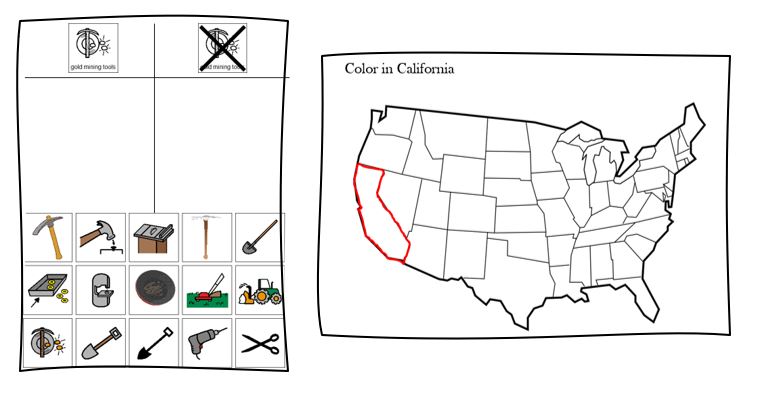
Hands-on activities for the California Gold Rush for kids
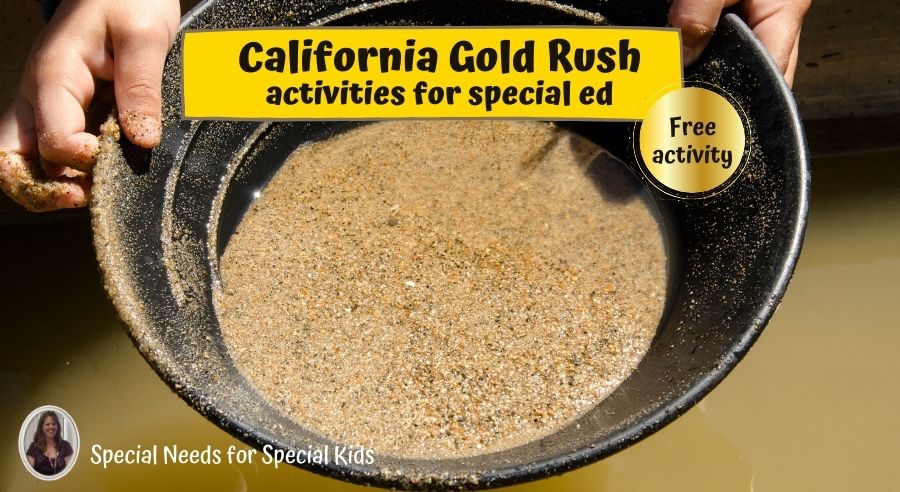
Who doesn’t like hands-on activities? These are a great way for students to make lasting connections, but they can also be a little hard to manage in some special education classrooms. I tried many different ways to give students the opportunity to pan for gold. Some years, the weather was great, and we could do it outside in a baby pool. This was the most fun, but also messy.
So, I came up with a way to give students a similar experience if we were stuck inside. You can download this complete activity, including the “What I learned” worksheet, for free by clicking the button below.

Review and Assessment
Finally, we want to have a clear understanding of how much of this new material our students have absorbed and comprehended. In order for that to be truly meaningful, you should ALWAYS start your unit with a pre-assessment. I use the actual assessment I will give at the end. That way, I can clearly see how much growth has occurred.
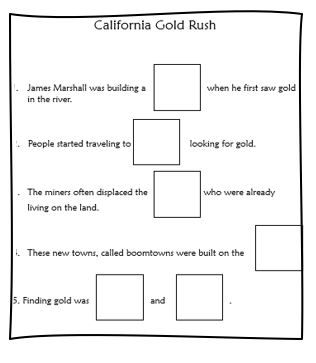
I like to use fill-in-the-blank worksheets for review and as a quick test to identify areas that need more instruction before the formal assessment. If the subject had many mini-topics, I might make several of these. They are usually short (only 5-10 questions) and cover a broad overview, as well as any particular area, I think students may have trouble with.
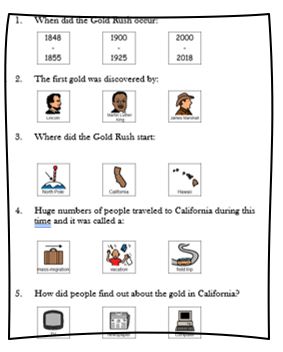
Finally, the assessment is typically 10 questions long and is a multiple-choice format. Because the needs and learning levels were so broad in my class, I use 3 different formats for presentations.
To check out my complete unit on the California Gold Rush, click the image below. It includes both print AND digital activities.