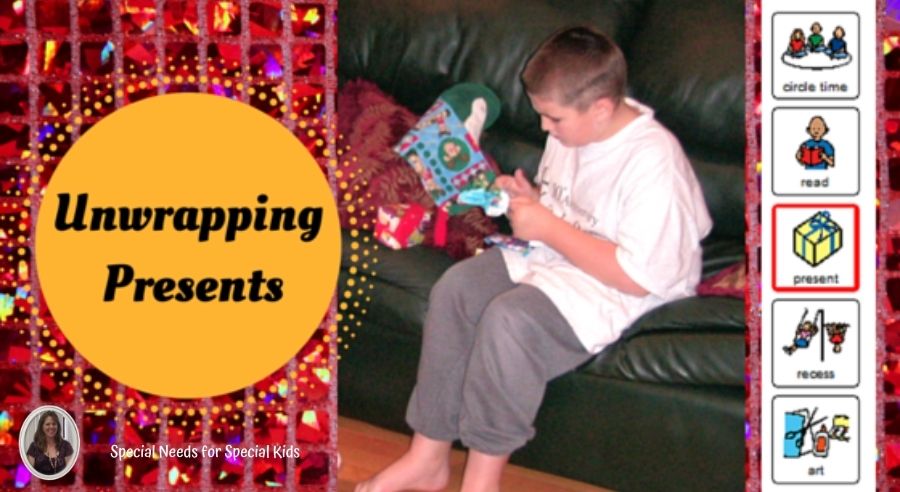
Remember how excited you would be on Christmas morning as a child? All those presents under the tree are just waiting to be unwrapped. Just as excited were the family members who had carefully picked out the perfect present for you. They waited anxiously to see your excited response as you revealed the treasure beneath all that Christmas paper and ribbon. Sadly, that often is not what happens in families who have a child with significant autism. These kids often do not want to open their presents, and when they do, they either show no reaction or react negatively to what is inside. Extended families, especially, can be confused or disappointed. Pressuring the child to open the gift and explore what is inside often makes the situation only worse. So, what can you, a special education teacher, do to help this situation at home? After talking it over with your students’ parents, read below to learn how to incorporate a present-unwrapping routine in your classroom.
1. Set a consistent time
Whatever class scheduling system you use, make sure there is a clear, consistent time set aside to work on this skill. I liked to start at the beginning of December, and even my most affected students made significant progress by Christmas. However, you may choose to start earlier if you feel your students will need more time. This consistency is critical for minimizing anxiety for your students around a routine that may have some historically negative feelings attached. In addition to this set time, make sure there is also time after the present is opened for the student to engage with the wrapped item. That may mean playing with a toy, watching a video, or eating a small snack. Immediate reinforcement will be very important for learning this skill.
2. Use high interest
When I did this program with my own child, I began by wrapping up his favorite things. I found things like books and toys around the house and would wrap them up. There is no need to go out and purchase new items; just use things you know your student REALLY loves. I also used food, but this may be more difficult at school. It is critical at the beginning to use only things you KNOW your student will want to engage with immediately upon unwrapping the package.
3. Use hand-over-hand prompts and fade
Find the least intrusive level of prompting your student needs at the beginning. You need a prompt invasive enough to ensure there is no anxiety, yet still allows as much independence as possible. Do not unwrap the present for the child, however. When working with my son, I had to start with hand-over-hand prompting. He hated unwrapping presents. Years of too much commotion, noise, people, and expectations had led him to have a very strong negative reaction to opening presents. So, I would help him open the present by taking my hands in his and ripping the paper off as quickly as possible. After a few days, I could tell he was building up confidence that there may be something good under that paper, and I could quickly fade to simply pointing and gesturing.
4. Keep it realistic
My personal preference is to keep the wrapping minimal, but realistic. You want your students to be able to open a present that most people will give them. That means using tape and some sort of bow. If you start this at the beginning, it is one less step you need to teach later. I also sometimes used boxes, and sometimes I did not. If something comes in a box, that is just one more “task” the child has to complete before the “job” is done. It is good to practice with and without boxes, so the child does not simply stop once the box is revealed.
5. Making it intermittent
Once you find that your students are easily opening their presents with little to no prompting, you need to start varying the level of desirability of the item. There are two main reasons for this. One, not every present they unwrap will be of high interest to them, of course. This is especially true when gifts are coming from people who may not know the child very well. The second, and more crucial reason, is that intermittent reinforcement is the strongest form of reinforcement there is. Research has shown again and again that a person is more likely to persist at a task longer when they are occasionally reinforced rather than every single time. Every gambling institution depends on it!! So, slowly introduce items that the student is not averse to, but may not be of peak interest to them. This will ensure they will not get tired of opening presents before Christmas morning is over.
Finally, I would provide the following tips to your parents, who should then share them with extended family members and friends:
- Limit the number of presents. Go for 1-2 fun things; don’t worry about all the kids getting the exact same number of items. That is not fair to anyone involved.
- Give the child time to open the presents on their own schedule. My son loves opening presents, but I still find I need to space them out and give him time to play with the items in between.
- Remove all unnecessary wrapping. If the toy is shrink-wrapped, then remove all the packaging before wrapping the item. This was hard for some of my family. They loved how it looked in the box and did not want to remove it before wrapping. However, more often than not, my son lost all interest before someone found scissors strong enough to cut through all the security wrapping.
- Put batteries in ahead of time if needed. For the same reason above, you want the child to enjoy the toy immediately when unwrapping it.
- Keep it simple. Encourage parents and family members to buy their favorite snacks or drinks and wrap them up. It may seem silly to wrap up a Snickers bar, but the reaction is likely to be 100 times better than wrapping up a pair of jeans.
So, that is my helpful hint for this week as we enter a crazy holiday season that is so challenging for our special learners. At least this can be one fun part of your day. Now, my son will open anyone’s present when I am not looking!! I think I did too good a job 🙂
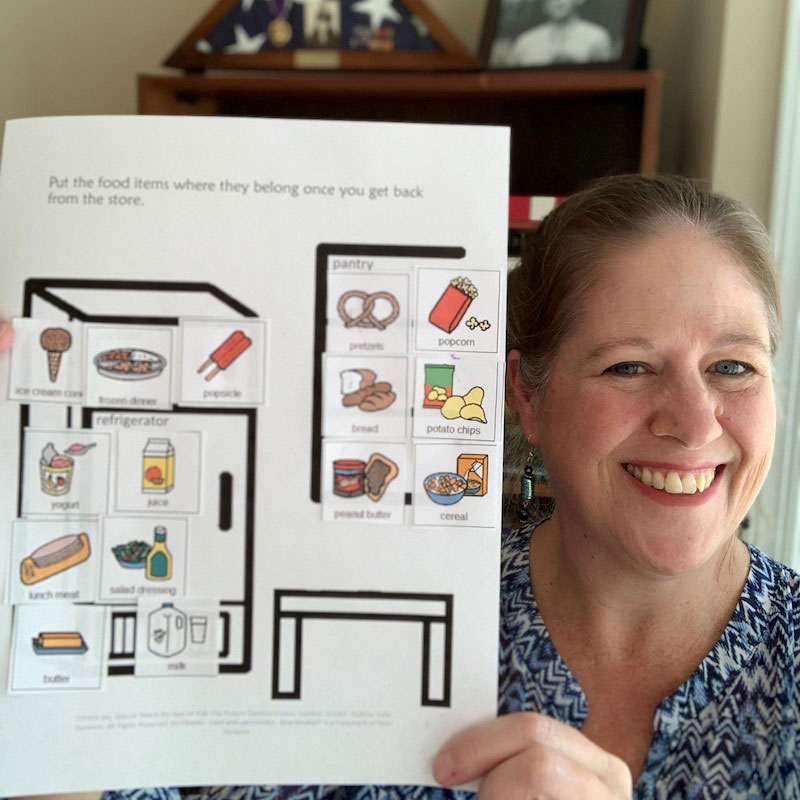
Here are the FREEBIES I promised. Click on the images below to grab them from my TPT store.


I also have other December units available to enhance your special education classroom.






One Comment
Comments are closed.